- Home
- Departments
- Public Works
- Operations Group
- Stormwater Division
- Clackamette Cove Water Quality
Clackamette Cove Water Quality
Cyanobacteria, also known as blue-green algae, naturally occur in surface waters. Under certain conditions, such as in warm water containing a lot of nutrients, they can rapidly form harmful algal blooms (HABs). HABs can negatively affect water quality by blocking sunlight, lowering oxygen levels in the water, and releasing toxins (cyanotoxins) that can harm humans and pets. Not all blue-green algae are toxic and toxic species don’t always release toxins.
HABs typically form a noticeable lime green film on the surface of the water (see photo below) but can sometimes appear brownish red below the surface. A visual guide can be found here, but as you can see by some of the comparisons, it is difficult to identify, and a single laboratory sample can cost almost $1,000.
In the summertime, the Cove is a prime example of an ideal environment for blooms to occur. There is little mixing with fresh water flowing in from the Clackamas River, so the water is at its calmest, and water temperatures tend to be at their highest.
In the past an increase in toxin-producing blooms has been linked to two major factors: increased nutrient concentrations from runoff (primarily nitrogen and phosphorus) and increasing water temperatures. Reducing nutrient pollution, such as nitrogen and phosphorus, is important for the long-term management of HABs and the risk they pose to public health and water quality. Oregon City has made significant improvements to its stormwater design standards to minimize pollution discharges (such as nutrients that feed HABs) to surface waters like the Cove.
In March of 2024, Aqua Insights was awarded a contract with the City of Oregon City to assess the water quality of the cove for recreational use, predict the likelihood of future HABs, and provide a list of alternatives to reduce the risk.
Additionally, Oregon City staff conduct visual monitoring weekly between May and October each year to look for evidence of a bloom. HABs are most likely to occur during these months, when the water is warm. If a bloom is observed, samples will be collected and tested for cyanotoxins. Oregon Health Authority (OHA) has set Recreational Use Values (RUVs) for cyanotoxins in surface water. If cyanotoxins are ever detected at concentrations above OHA’s RUVs, signs will be posted in and around the site and residents will be notified to stay out of the water.
When in doubt, stay out! If the water looks foamy, scummy, thick like paint, pea-green, blue-green, or brownish-red it could be evidence of a HAB, and you should not go in the water. If you see something you suspect to be a HAB, call Public Works - Water Quality at (971) 204-4600.
In September of 2015 a small bloom was observed at the northeastern shore and confirmed by laboratory analysis. The bloom dissipated a few weeks later.
Risks to dogs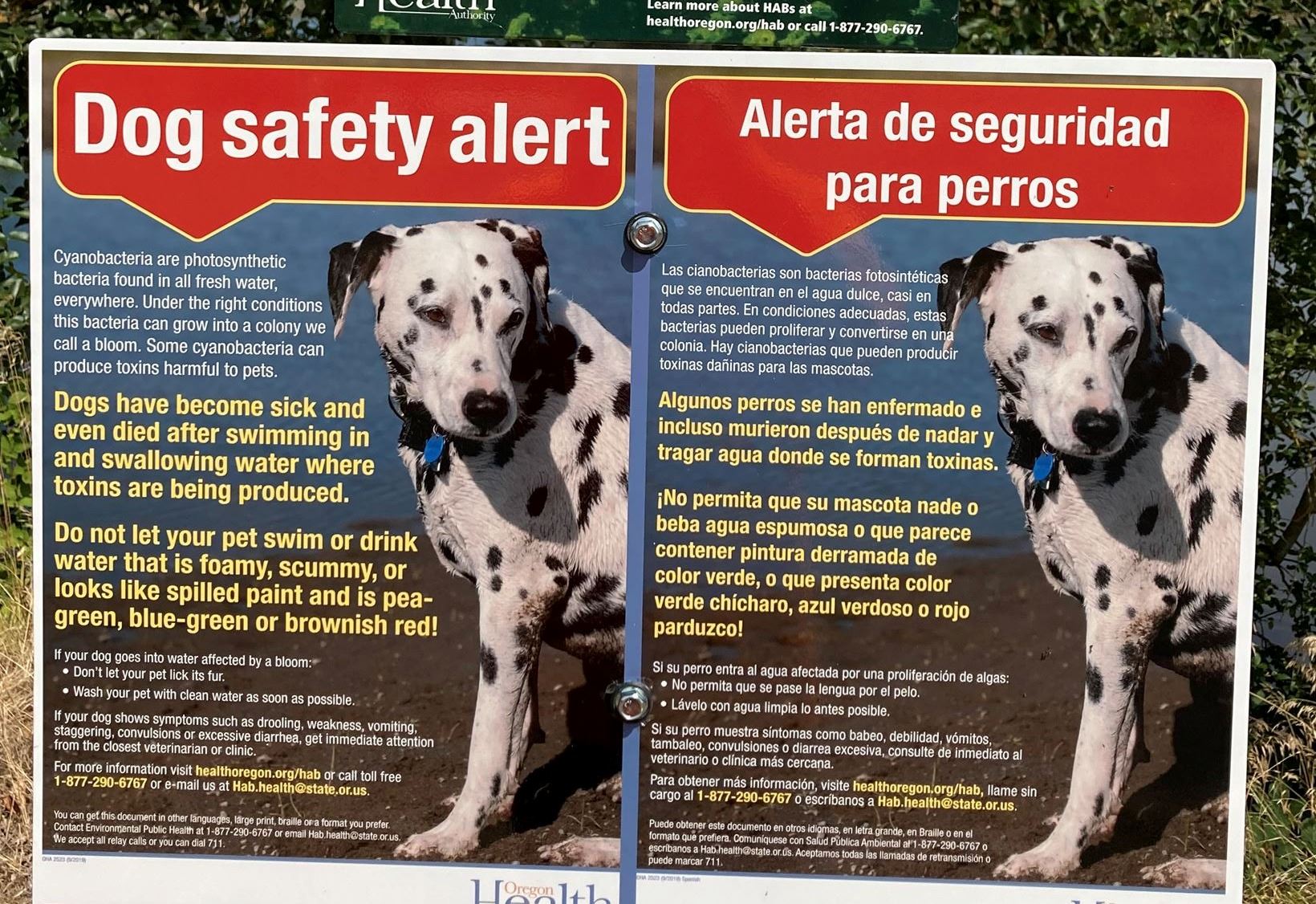
Animals are extremely sensitive to cyanotoxins (more sensitive than humans) and can become very ill or potentially die due to exposure at low levels. The primary route of exposure to these toxins is through ingestion. Ingestion occurs when pets or wildlife drink water from a cyanobacteria-filled lake or pond, lick their fur after swimming, or eat dried cells that accumulate along the shoreline.
Because dogs are cyanotoxin sensitive animals and dog deaths have been confirmed due to HABs, OHA developed dog-specific recreational use values (RUVs) for cyanotoxins. However, OHA does not use the dog-specific RUVs for public health advisories. They are offered more as a resource for veterinarians when treating dogs believed to have been exposed to cyanotoxins.
If cyanotoxins are detected above the dog-specific RUVs, Oregon City will post special warning signs at the main access points to the cove. If you plan to take your dog to the cove between May and October, please check the posted signs when you arrive to make sure the water is safe for your pet!
Fish Consumption
At this time, there is insufficient information to determine the risk of consuming fish caught in waters with cyanotoxins. Studies have shown that toxins mainly accumulate in the liver and viscera of fish, and small amounts of microcystin has been detected in the fillet. At a minimum, organs and skin should be removed and discarded, and fillets rinsed with clean water prior to cooking or freezing. Caution should be taken with shellfish as cyanotoxins have been shown to accumulate in edible tissue.

.png)